


Why Some Children Struggle to Make Friends

Inspired by Jesse
This guide is dedicated to Jesse, who chose the importance of free play as the topic of his school speech. His thoughtful idea reminded me of something we can all forget from time to time: that some of childhood’s most important learning, and many meaningful friendships, grow through play. Thank you for the inspiration, Jesse.
As an adult, I’ve realised that I approach friendships in a particular way. I’m not someone who walks into a room and immediately starts talking to everyone.
I enjoy meeting new people, but I also enjoy observing. I like to take in the atmosphere, listen to conversations, and understand the people around me before joining in.
Over the years, I’ve also realised that I’m happiest with a small circle of meaningful relationships. I don’t need to know everyone in the room. I’d rather have one or two genuine conversations than lots of brief interactions. For me, friendship has never been about quantity, it has always been about connection.
Perhaps that’s why this concern resonates with me whenever parents bring it into the therapy room.
In my work as a play therapist, one of the concerns I hear very often is, “My child is struggling to make friends.”
Sometimes it’s because a child prefers to play alone before joining a group. Sometimes they have one close friend while another child seems to know everyone in the class.
Other times, parents tell me their child spends lunchtime drawing, reading, or building something on their own, and they worry that they might be lonely.
These concerns are completely understandable. We all want children to feel accepted, connected, and like they belong.
But what if your child is simply taking their time?
What if they are observing before participating, just as some adults do?
And what if making friends isn’t simply about being outgoing or naturally social, but about many different developmental skills gradually coming together over time?
One of the biggest misconceptions about childhood friendships is the belief that children either “have social skills” or they don’t. In reality, friendship is far more complex than that. It develops alongside emotional regulation, communication, language, flexible thinking, confidence, perspective-taking, executive functioning, and opportunities to practise these skills through play.
Just as children learn to walk, read, and solve problems at different ages, they also develop friendships at different rates. Their temperament, life experiences, developmental stage, and individual strengths all influence how they connect with others.
Research into temperament reminds us that children are born with different ways of responding to the world. Developmental psychologist Mary Rothbart describes temperament as biologically based differences in emotional reactivity and self-regulation, meaning that some children naturally approach new situations with enthusiasm while others need more time to observe, process, and feel safe before engaging. Neither approach is better, they’re simply different.
At the same time, researchers such as Adele Diamond have shown us that many of the skills needed for successful friendships, such as self-control, working memory, attention, and cognitive flexibility, continue developing throughout childhood.
Friendship, therefore, isn’t a fixed personality trait. It’s an ongoing developmental journey.
As a play therapist, I often remind parents that our goal isn’t to help children become the most popular child in the class. Our goal is to help them develop the confidence, emotional safety, and relationship skills that allow genuine friendships to grow.
Some children will have many friends.
Others will have one or two.
Both can be thriving.
Because friendship isn’t measured by numbers.
It’s measured by connection.
In this guide, we’ll explore how friendships develop throughout childhood, why some children find them more challenging than others, and how play provides one of the most powerful foundations for building meaningful, lasting relationships.
What Does Friendship Really Mean?
When parents tell me they’re worried about their child’s friendships, one of my first questions is:
“What does friendship look like for a child of this age?”
It’s an important question because our expectations of friendship are often based on our own adult experiences. We think about trust, loyalty, shared interests, and spending time with people who make us feel understood. But children don’t begin with those kinds of relationships. Like every other area of development, friendship grows and changes over time.
A two-year-old playing happily beside another child may already be taking important first steps towards friendship.
A preschooler who proudly says, “She’s my best friend!” one day and “We’re not friends anymore!” the next isn’t necessarily experiencing relationship difficulties. They’re learning.
An older child who seeks out one trusted friend rather than a large group may have developed exactly the kind of friendship that feels meaningful to them.
Friendship isn’t something children suddenly achieve. It’s something we gradually build through thousands of everyday interactions, shared experiences, disagreements, repairs, and moments of connection.
Developmental sociologist Mildred Parten was one of the first researchers to describe how children’s play changes as they grow. Her work reminds us that play isn’t simply entertainment, it’s one of the primary ways children learn how to be with other people.
Young toddlers often engage in parallel play, where they play alongside another child without necessarily interacting very much. To an adult, it might not look particularly social. But these children are observing one another, becoming comfortable sharing space, and beginning to notice what others are doing.
As children move into the preschool years, their play gradually becomes more interactive. They begin to share ideas, negotiate roles, cooperate towards common goals, and create imaginative worlds together. This is where many of the foundations of friendship begin to emerge.
During the early primary school years, friendships often become centred around shared interests and activities. Children may enjoy similar games, hobbies, or sports, and these common experiences help strengthen their connections.
As children grow older, friendships become increasingly based on trust, loyalty, emotional support, and mutual understanding. They begin to appreciate different perspectives, keep confidences, resolve disagreements more thoughtfully, and value friends who make them feel accepted for who they are.
Researchers such as Hartup, Rubin, and Howes have shown that friendships continue to evolve throughout childhood. They aren’t simply about having someone to play with, they become important relationships that support emotional wellbeing, resilience, confidence, and a sense of belonging.
This means that asking, “Does my child have friends?” may not always be the most helpful question.
Instead, we might ask:
Are they gradually developing the skills that allow friendships to grow?
Are they having opportunities to connect with others in ways that feel safe and meaningful for them?
Those questions shift our focus from measuring friendships to understanding development.
And that’s often where reassurance begins.

Friendship Is More Than Being Social
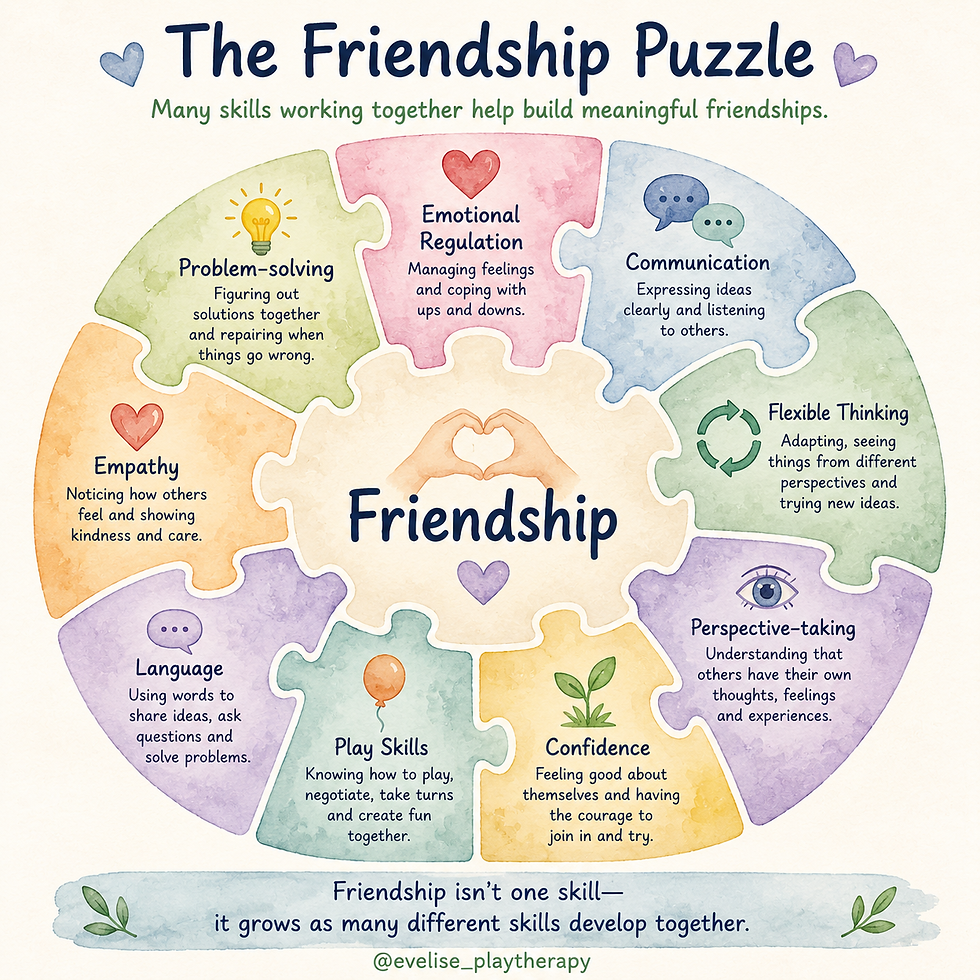
When we think about friendship, it’s easy to assume that some children are simply “good with people” while others are not. But friendship isn’t a single skill. It’s the result of many different abilities developing and working together over time.
Imagine trying to complete a puzzle with only a few pieces. You might be able to see part of the picture, but it won’t feel complete until the other pieces gradually fall into place.
Friendship develops in much the same way.
Children aren’t born knowing how to take turns, manage disappointment, understand another person’s perspective, or solve disagreements. These are skills that develop throughout childhood, supported by nurturing relationships, everyday experiences, and, most importantly, opportunities to play.
A child might be confident starting conversations but find it difficult to cope when a game doesn’t go their way.
Another child may have wonderful ideas during imaginative play but struggle to understand how someone else is feeling.
A child with a rich vocabulary may still find it challenging to read social cues or join a group already engaged in play.
These children aren’t “bad at friendship.” They’re developing different pieces of the puzzle.
One of the most important pieces is emotional regulation. Friendships naturally involve excitement, disappointment, frustration, compromise, and conflict. When children are beginning to recognise and manage these big emotions, they’re better able to stay connected, even when things don’t go as planned.
Another important piece is executive functioning, a group of thinking skills that help children pay attention, remember information, control impulses, switch between ideas, and solve problems. Developmental psychologist Adele Diamond’s research has shown that these abilities continue developing well into adolescence, helping children become more flexible, thoughtful, and responsive in their interactions with others.
Children also gradually develop perspective-taking, sometimes called Theory of Mind. This is the ability to understand that other people have their own thoughts, feelings, beliefs, and experiences. It’s what helps a child recognise that a friend may enjoy a different game, feel upset by something they didn’t notice, or see a situation differently from the way they do.
Alongside these skills, children are learning to communicate their ideas, negotiate, cooperate, solve problems, use language effectively, and build confidence through repeated social experiences.
None of these abilities develop in isolation. They influence one another every day.
A child who feels emotionally safe is often better able to think flexibly.
A child with stronger language skills may find it easier to negotiate during play.
A child who can regulate disappointment is more likely to repair a friendship after a disagreement.
Little by little, each new experience strengthens another piece of the puzzle.
This is one of the reasons I encourage parents to look beyond the question, “How many friends does my child have?”
Instead, we might ask:
Which friendship skills are already developing?
Which ones are still growing?
When we begin to see friendship as a collection of developing abilities rather than a measure of popularity, we replace pressure with understanding.
And that’s where children are most likely to flourish.
Why Some Children Find Friendships More Difficult
We all want to feel connected!
We might not always seek connection in the same way or at the same time, but feeling accepted, understood, and that we belong is a deeply human need.
So why does making friends seem to come so naturally for some children, while others appear to struggle?
There isn’t one simple answer.
Just as children develop at different rates physically, emotionally, and cognitively, they also develop socially in their own unique way. Their ability to build friendships is influenced by many factors, including temperament, emotional development, communication, life experiences, and the opportunities they’ve had to practise being with others.
One of the biggest influences is temperament.
Some children are naturally cautious. They prefer to watch before joining in, think before speaking, and become familiar with new people before feeling comfortable enough to engage. Others seem ready to introduce themselves to everyone they meet within minutes.
Neither temperament is better than the other.
A child who takes time to warm up isn’t necessarily shy, unfriendly, or lacking confidence. They may simply need more time to feel emotionally safe before connecting.
Some children also experience anxiety, making social situations feel genuinely overwhelming. Joining a game, starting a conversation, or asking to play can require enormous courage. What looks like avoidance from the outside may actually be a child doing their very best to manage feelings of uncertainty.
For other children, emotional regulation is still developing. They may become overwhelmed when games don’t go their way, struggle to recover after disagreements, or find it difficult to manage frustration. These moments don’t mean they’re incapable of friendship, they simply show that another piece of the friendship puzzle is still growing.
Children who are neurodivergent, including many autistic children and children with ADHD, may experience friendships differently. They may communicate in unique ways, have passionate interests, prefer different styles of play, or become overwhelmed by busy social environments. Many neurodivergent children form deep, genuine, and lasting friendships, particularly when they feel accepted for who they are rather than expected to socialise in ways that don’t feel natural to them.
Some children are still developing language skills, making it harder to explain their ideas, join conversations, negotiate during play, or express how they’re feeling.
Others experience sensory differences. A noisy playground, crowded classroom, or unpredictable group activity may be exhausting rather than enjoyable. Choosing quieter play or spending time with one trusted friend may be exactly what helps them connect best.
Life experiences also shape friendships. Changes such as moving house, changing schools, family separation, grief, illness, trauma, or long periods away from peers can all influence how comfortable children feel in social situations. Sometimes children need time to rebuild a sense of safety before they feel ready to connect with others again.
When we understand these different influences, we begin to see something important.
Children aren’t all climbing the same mountain from the same starting point.
Each child brings their own temperament, strengths, experiences, and developmental journey.
Rather than asking,
“Why can’t my child make friends?” we might gently wonder,
“What might be making friendship feel difficult right now?”
That single shift replaces judgement with curiosity.
And curiosity is often the first step towards understanding how to support a child with compassion.
Why Play Is Where Friendships Grow
When adults think about friendship, we often picture conversations.
Children, however, build friendships differently.
Their language is play.
It’s through play that children first learn how to be with another person. Before they can have long conversations about their feelings or navigate complex relationships, they explore connection by building towers together, pretending to run a café, creating imaginary worlds, inventing games, or laughing over something wonderfully silly.
From the outside, it may simply look like fun.
But beneath every game, an incredible amount of learning is taking place.
During play, children are constantly practising the very skills that friendships depend on.
They learn to wait for a turn, negotiate roles, share ideas, solve disagreements, recover when something doesn’t go as planned, and experience the joy of creating something together.
Every time children decide who will be the doctor and who will be the patient, they are learning to compromise.
Every time they change the rules of a game to include someone else, they are practising flexible thinking.
Every time they comfort a friend whose block tower has fallen down, they are developing empathy.
Every time they disagree, work through the problem, and continue playing together, they discover something incredibly important:
Relationships can be repaired.
This is one of the greatest gifts that play offers children.
Friendships aren’t built because everything goes perfectly.
They’re built because children learn that moments of frustration, disappointment, and conflict don’t have to mean the end of a relationship.
Instead, they become opportunities to listen, adapt, apologise, forgive, and reconnect.
Developmental psychologist Lev Vygotsky believed that children learn through shared social experiences. During play, children naturally support one another’s learning, stretching their thinking and trying new ideas together in ways that wouldn’t happen alone.
Play researcher Karen Stagnitti’s work also highlights how rich imaginative play supports language, social competence, self-regulation, planning, flexible thinking, and problem-solving, all of which contribute to children’s ability to build and maintain friendships.
Peter Gray goes even further, describing free play as one of childhood’s greatest teachers. When adults step back and allow children the freedom to create, negotiate, make mistakes, and solve problems together, they develop independence, confidence, resilience, and the social understanding that meaningful friendships require.
As a play therapist, I see this every week.
Children rarely walk into the therapy room saying, “Today I’d like to work on perspective-taking.”
Instead, they invite me into a game.
Together, we build, imagine, create stories, solve problems, negotiate rules, laugh, repair misunderstandings, and discover new ways of relating to one another.
From the outside, it still looks like play.
But underneath, children are practising relationships.
This is why I gently encourage parents to protect unhurried opportunities for play.
Not every afternoon needs to be filled with organised activities.
Not every disagreement needs an adult to solve it immediately.
Sometimes children need time to work things out together, to make mistakes, to repair, and to experience the satisfaction of finding their own way back to connection.
Because when children play, they’re doing far more than passing the time.
They’re learning how to build friendships that can last a lifetime.

How Adults Can Support Friendships Without Pushing Them
As adults, it’s natural to want to help.
When we see a child standing on the edge of a group, playing alone at lunchtime, or coming home disappointed after a difficult social experience, our instinct is often to step in and make things better.
Sometimes that’s what’s needed.
But often, children need something slightly different.
Rather than pushing them towards friendship, they need adults who gently create the conditions where friendship has room to grow.
Think of it like tending a garden.
We can’t make a flower bloom by pulling on its petals.
But we can provide sunshine, water, healthy soil, and time.
Friendship grows in much the same way.
- Focus on Connection, Not Popularity
It’s easy to become caught up in how many friends a child has.
Instead, notice the quality of their relationships.
One trusted friend who makes your child feel safe, accepted, and understood can be far more valuable than belonging to a large group where they don’t truly feel like themselves.
- Respect Your Child’s Temperament
Some children need time before they feel comfortable joining others.
Resist the urge to label them as “shy” or apologise for their quietness.
Instead, acknowledge what you see.
“You like to watch for a little while before joining in.”
That simple observation accepts who they are without suggesting they need to be different.
- Create Opportunities Without Pressure
Friendships often develop more easily in calm, predictable settings.
Instead of arranging large gatherings, consider inviting one child over for a playdate or meeting another family at a local park.
Children who become overwhelmed in busy groups often thrive when they have the chance to connect with just one peer.
The goal isn’t to manufacture friendship.
It’s simply to create opportunities where connection can happen naturally.
- Protect Time for Play
Children don’t build friendships by completing worksheets about kindness or memorising conversation starters.
They build friendships by playing.
Unhurried play gives children opportunities to negotiate, imagine, solve problems, experience disagreements, and repair relationships together.
These everyday moments are where social confidence quietly grows.
- Coach Rather Than Rescue
When children experience friendship difficulties, it’s tempting to solve the problem immediately.
Instead, become a curious coach.
Ask questions like:
“I wonder what happened.”
“How do you think your friend was feeling?”
“What could you try next time?”
Rather than giving children all the answers, these conversations help them develop their own problem-solving skills and confidence.
- Support Emotional Regulation First
Friendships are much easier to navigate when children feel calm and emotionally supported.
If a child is overwhelmed, tired, hungry, anxious, or dysregulated, social situations become much more difficult.
Connection with a trusted adult often comes before connection with peers.
By helping children feel safe and regulated, we also strengthen the foundations they need for healthy friendships.
- Celebrate Courage and Kindness
Instead of praising children only when they make a new friend, notice the smaller moments that often go unseen.
“I noticed you asked if you could join their game.”
“That was kind of you to help when your friend was upset.”
“You kept trying, even though it felt difficult.”
These moments reflect the qualities that help friendships grow over time.
- Trust the Process
Perhaps the most important thing we can offer children is patience.
Friendship isn’t a race.
Some children build relationships quickly.
Others build them slowly and deeply.
Neither path is better.
Every child deserves the time to develop friendships in a way that feels genuine to them.
As adults, we can’t choose our children’s friends.
We can’t make another child include them.
And we can’t force connection.
But we can create environments where children feel emotionally safe, accepted for who they are, and free to discover the joy of genuine friendship in their own time.
Sometimes, that’s the greatest gift we can give.
Common Myths About Childhood Friendships
As adults, it’s easy to carry assumptions about friendship that simply aren’t true. Let’s explore a few of the most common myths.
Myth 1: Children who play alone are lonely.
Not necessarily.
Many children genuinely enjoy spending time on their own. Solitary play allows them to recharge, explore their interests, and use their imagination. Some children move comfortably between playing alone and playing with others, while others simply need a little more time before joining a group.
Playing alone is only a concern if it’s accompanied by distress, persistent isolation, or a child who wants to connect but doesn’t know how.
Myth 2: Outgoing children always have better friendships.
Outgoing children may find it easier to start conversations, but that doesn’t automatically lead to deeper or more meaningful friendships.
Likewise, quieter children often build incredibly strong, lasting relationships because they value trust and emotional connection.
Friendship isn’t about personality.
It’s about relationships.
Myth 3: Friendship can’t be taught.
While we can’t teach friendship through a checklist, children absolutely learn the skills that support friendship.
Through play, caring relationships, and everyday experiences, they gradually develop communication, empathy, emotional regulation, flexible thinking, and problem-solving.
Friendship grows from these experiences.
Myth 4: More friends means happier children.
Quality almost always matters more than quantity.
One safe, accepting friendship can have a profound impact on a child’s wellbeing.
Children don’t need to be popular.
They need to feel that they belong.
When Might It Be Helpful to Seek Support
Every child develops social skills at their own pace, and there is enormous variation in what is considered typical.
However, it may be helpful to seek additional support if your child:
becomes consistently distressed about friendships
wants to make friends but doesn’t know how to join or maintain play
regularly experiences conflict that doesn’t improve with support
avoids social situations because they feel overwhelming or frightening
shows significant anxiety around peers
has experienced trauma, grief, or major life changes that are affecting relationships
has communication, developmental, or sensory differences that are making social interactions particularly challenging.
Seeking support doesn’t mean something is wrong with your child.
Sometimes it simply provides another caring adult who can help understand what’s getting in the way and build on your child’s existing strengths.
Key Takeaways
Friendship develops gradually throughout childhood.
Every child follows their own unique developmental pathway.
Friendship is built on many different skills, including emotional regulation, communication, empathy, flexible thinking, and problem-solving.
Play provides children with natural opportunities to practise these skills every day.
Different doesn’t mean deficient.
One meaningful friendship is often more valuable than many superficial ones.
Adults don’t need to create friendships, they can create the conditions in which friendships naturally grow.
A Gentle Reminder
Some children collect friends wherever they go.
Others collect moments.
One trusted friend.
One meaningful conversation.
One shared game.
One person who makes them feel understood.
Friendship isn’t measured by numbers.
It’s measured by connection.
And like everything important in childhood, it grows best when children are given time, understanding, and the freedom to be themselves.
Continue the Conversation
Books for Parents
The Importance of Being Little – Erika Christakis
A thoughtful exploration of childhood, relationships, and the importance of play.
The Whole-Brain Child – Daniel J. Siegel & Tina Payne Bryson
A practical guide to understanding children’s emotional and social development through the lens of brain development.
Play to Learn – Karen Stagnitti
An excellent introduction to how imaginative play supports children’s learning, communication, and social competence.
Children’s Books
Enemy Pie by Derek Munson
A beautiful story about friendship, misunderstandings, and giving others a chance.
The Invisible Boy by Trudy Ludwig
A gentle story about inclusion, kindness, and helping every child feel they belong.
Will You Be My Friend? by Sam McBratney
A lovely picture book exploring the beginnings of friendship for younger children.
Podcasts
The Curious Neuron Podcast
Evidence-based conversations about child development, emotions, and parenting.
Unruffled with Janet Lansbury
Thoughtful discussions about respectful parenting, emotional development, and relationships.
The Play Therapy Podcast (Association for Play Therapy)
Insights into children’s emotional development and the therapeutic power of play.

A Note for Readers
This guide is intended for educational and informational purposes and is not a substitute for individual therapeutic, medical, or professional advice.
Every child develops at their own pace, and there is a wide range of what is considered typical. If you have concerns about your child’s development, emotional wellbeing, friendships, or behaviour, consider speaking with a qualified health or education professional who can provide guidance tailored to your child’s individual needs.
If you’re looking for additional support, play therapy can provide children with a safe, developmentally appropriate space to explore emotions, strengthen relationships, and build the skills that support meaningful connections.
If this guide helped you better understand the children in your life, consider sharing it with another parent, educator, or professional.
Together, we can create a world where every child is understood, supported, and given the opportunity to thrive.
References
Diamond, A. (2013). Executive functions. Annual Review of Psychology, 64, 135–168. https://doi.org/10.1146/annurev-psych-113011-143750
Gray, P. (2013). Free to learn: Why unleashing the instinct to play will make our children happier, more self-reliant, and better students for life. Basic Books.
Hartup, W. W., & Stevens, N. (1997). Friendships and adaptation in the life course. Psychological Bulletin, 121(3), 355–370. https://doi.org/10.1037/0033-2909.121.3.355
Howes, C. (1983). Patterns of friendship. Child Development, 54(4), 1041–1053.
Parten, M. B. (1932). Social participation among preschool children. Journal of Abnormal and Social Psychology, 27(3), 243–269. https://doi.org/10.1037/h0074524
Rothbart, M. K. (2011). Becoming who we are: Temperament and personality in development. Guilford Press.
Rubin, K. H., Bukowski, W. M., & Bowker, J. C. (2015). Children in peer groups. In R. M. Lerner (Ed.), Handbook of child psychology and developmental science (7th ed., Vol. 4). Wiley.
Siegel, D. J., & Bryson, T. P. (2020). The power of showing up: How parental presence shapes who our kids become and how their brains get wired. Scribe.
Stagnitti, K. (2009). Play as therapy: Assessment and therapeutic interventions. Jessica Kingsley Publishers.
Vygotsky, L. S. (1978). Mind in society: The development of higher psychological processes. Harvard University Press.


Comments